ST. JOHN’S, NL – Fisheries and Oceans Canada (DFO) provided an update from the most recent 3Ps Atlantic cod assessment held in St. John’s from November 4–6, 2025. Fish harvesters Jamie Barnett and Ken Viscount participated in the meeting along with Erin Carruthers, FFAW Fisheries Scientist.
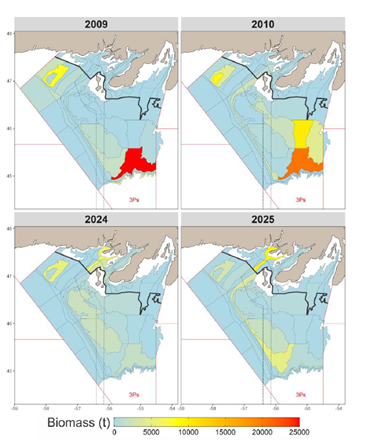
The assessment showed that 3Ps cod remains in the Critical Zone and has not achieved the growth predicted from previous assessments. Importantly, the assessment also showed a significant loss of offshore components—losses that have been a long time coming, playing out warnings that FFAW raised over a decade ago.
Building from this assessment will require, first reckoning with how we got here and second increased understanding of current stock structure and movements.
Longstanding Concerns Proven Right
During the brief period that the 3Ps cod stock was Marine Stewardship Council (MSC) certified, FFAW-Unifor objected to that certification on the grounds that the assessment of the stock was overly optimistic. The Union repeatedly raised concerns about offshore draggers fishing on vulnerable winter aggregations and spawning fish, which accelerated the loss of offshore components now clearly evident in the data. These concerns are documented our objection to the 2015 certification of 3Ps cod.
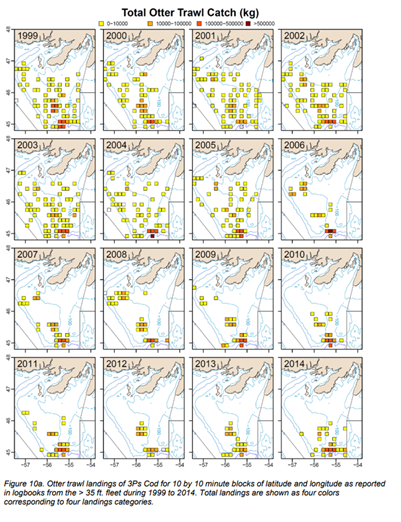
The technical briefing released today showed that cod have largely disappeared from the offshore portions of the DFO research vessel survey, including the Halibut Channel—areas that once supported significant fishing activity. In 2016, the last year that DFO provided maps of fishing locations in the assessment, the heat maps of offshore dragging show a contraction of the fishery and a concentration in the Halibut Channel (See attached pictures).
The patterns seen in 3Ps, with increased concentration offshore dragging, echoes patterns seen in the lead-up to the northern cod collapse.
“Sound familiar?” asks FFAW President Dwan Street. “We’ve seen this before. When northern cod collapsed, the same thing happened—offshore effort was concentrated on remaining cod aggregations while inshore harvesters struggled to fill their quotas. We need to learn from those mistakes, not repeat them.”
“This doom and gloom assessment was a long time coming. Inshore harvesters have been saying for years that the stock was overestimated and was being hammered offshore. If this was just about warming water, we’d be seeing those fish move inshore,” says long-time fish harvester and Inshore Council member, Alfred Fitzpatrick. “We’re not seeing that. The fish were taken, and it shouldn’t have happened. This was poor management.”
Changes in Timing and Distribution
Moving forward, many inshore harvesters are reporting that cod are arriving later in bays and that larger fish are being seen in deeper waters, particularly in Fortune Bay.
“We’re seeing a shift in timing and distribution,” says Barnett, Inshore Council Member for St. Brides to Swift Current. “It raises the question of whether current survey timing—both DFO’s offshore RV survey and our shared inshore sentinel survey—needs to be adjusted to capture these changes.”
Moving forward, it will be important to track these changes in distribution and movement, both in 3Ps and in the adjacent stock areas, such as 3L.
A Call for Reflection and Reform
The assessment results make clear that the 3Ps cod stock is in trouble, and that the collapse of offshore components occurred during years when science and management underestimated the risks.
“It’s important to remember that there was a major revision to our understanding of the stock,” explains Erin Carruthers, FFAW Fisheries Scientist. “In 2019, DFO led a major reassessment of 3Ps cod which resulted in the current assessment model, which shows that this stock was below the Limit Reference Point for over 20 years, which means that loss of offshore components was underway during the period when stock status was overestimated.”
“We can’t fix the past, but we can take responsibility for how we manage the future,” concludes Carruthers. “This means revisiting the rebuilding plan, it means listening to the people on the water, and it means tracking – and importantly reviewing changes in the distribution of fish and fleets within a stock area.”